I Distilled Fable's Review into Rules, Then Showed the Same Reviewer This Post
My last post fell apart when I had Claude Fable 5 read it.
Post 1049 was written by Opus 4.8 and Sonnet 5, and Fable 5’s review came back with 11 findings. The closing asserted “I had misjudged this” with no scene in the body to back it up. The twist was spoiled by bringing up Analyze Requirements right before the reveal. A catchphrase from a discarded draft was still sitting in the conclusion. The summary table had a row the body never touched. Every one of them was the kind of defect you only catch by reading the whole thing straight through.
I folded in the findings, rewrote from the core, and published. But I didn’t stop there: I distilled those findings into four standing rules and wrote them into my post-writing playbook (the new-post skill) and CLAUDE.md. This post is the test of how much that distillation actually bought.
Boiling 11 findings down to 4 rules
Of the findings Fable 5 raised against post 1049, four could be reduced to a form I can reuse next time.
The primary-source gate. If a post’s argument depends on how an external product works, fetch the official docs before writing. Post 1049 ran on secondhand information partway through — I assumed Kiro sold speed by skipping spec review, and the official docs said the opposite, forcing a rewrite from the core. So the rule became: don’t defer research to the review stage.
Full rewrite on a pivot. If the post’s central axis changes midway, don’t just patch the parts that changed. Reread everything against the new axis — the hook, the catchphrase, headings, tables, the conclusion. Among 1049’s 11 findings, both the unsupported self-reference and the leftover catchphrase were traces of skipping this pass.
A “why” for the central claim. Whatever the conclusion asserts, the body must carry at least one reason for it. No bare declarations.
No orphan table rows. Every row in a summary table gets touched at least once in the body. If a row isn’t, cut it or write it in.
Of these, only two can be checked mechanically, as a present-or-absent test: the primary-source gate and the orphan-row ban. Whether I cited primary sources shows up in the links; orphan rows can be counted by matching the table against the body. The other two — the full rewrite on a pivot, the why requirement — are judgment calls about whether things cohere, closer to enforced procedure than to rules. I lined all four up as “rules,” but only half are checkable by machine.
And of the four examples I opened with, the spoiled twist (Analyze Requirements surfacing right before the reveal) maps to none of the four rules. “Did I give it away too early” isn’t about the presence or absence of an element; it’s about the order of the telling, a different axis entirely. It slipped through the distillation.
Making this post the experiment
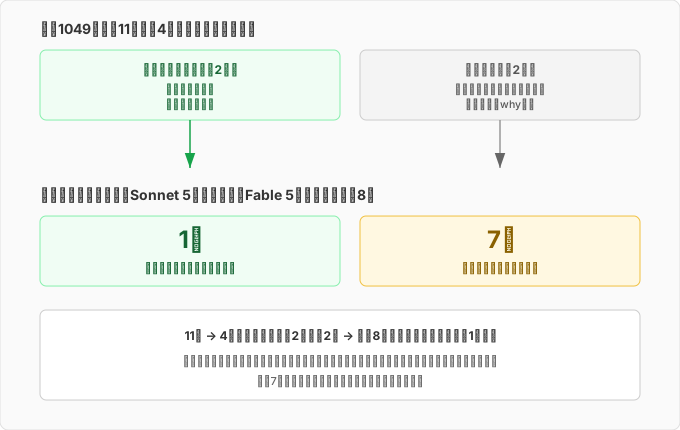
Writing rules down doesn’t tell you whether they work. So I had Sonnet 5 write this post under the new rules, and once the draft was done, handed it to the same Fable 5 for review. It came back with 8 findings, one of them minor. Three fewer than 1049’s 11.
The breakdown left no room for optimism. Of the 8, exactly one was the kind my four rules could have caught mechanically: the version sent for review had a word in its summary table that appeared nowhere in the body — a variant of the orphan-row problem, resolved by rewriting the table into its current form. The other 7 were defects newly born inside this post. The title and conclusion asserted the results of an experiment the article never actually reported. The conclusion abruptly introduced the fact that Fable 5’s free window had ended, with no support anywhere in the body (in reality, the free period ending just means usage-based billing — the model didn’t go away). One paragraph declared all four rules machine-checkable, and the next section said some findings can only be caught by reading; my own taxonomy split in half. All 7 are fixed in the version you’re reading.
What wouldn’t distill
Before writing, I figured the distillation had captured about half. The measurement came in harsher: 7 of 8 findings matched none of the four rules.
The reason is the same across all of them. My current rules test for presence: did I cite a primary source, does each table row have matching body text. Most of this round’s findings were about relations — whether elements contradict each other, whether a claim gets paid off somewhere in the piece. Checking whether something exists fits a checklist. Checking whether things agree does not.
So the answer was never to convert every finding into a rule. Put the top model only where quality of judgment is the constraint — the review that checks whether a post holds together — and from its findings, distill only the machine-checkable share into rules that flow downstream. Everything else goes back to the top model next time too. This measurement says “everything else” is the larger share.
The tally
| Post 1049 (written by Opus/Sonnet) | This post (Sonnet, under the new rules) | |
|---|---|---|
| Writing | Opus 4.8 + Sonnet 5 | Sonnet 5 (4 rules applied) |
| Review | Fable 5 | Fable 5 |
| Findings | 11 | 8 |
| Caught mechanically by existing rules | (n/a — rules didn’t exist yet) | 1 (orphan table row) |
| Catchable only by reading | 11 | 7 |
Closing
Fable 5’s free window is over, and I still fed it this post for review. It didn’t go away; the free allowance ran out and it now bills by usage. Paying for the top model only where quality of judgment matters — the review that audits a post’s coherence — is a call I didn’t have to agonize over on paper. This post already made it in practice.
Eleven findings became eight. Rules prevented one of them; the other seven were once again caught by having the top model read the thing. I don’t know how that split moves in the next post. What I do know is that, for now, I’ll keep paying the top model for those seven findings’ worth of reading.
comments powered by Disqus