Before the Meter Started Running, I Had the AI Build an 'Environment' Instead of a Deliverable
Honestly, I can’t keep up with how fast AI models are turning over lately. A new one shows up every few days, and whatever was “the best” a moment ago is already last-gen. The incident I mentioned in an earlier post — a model that got cut off just three days after launch — is part of the same story.
In the middle of all that, I noticed something about my own plan: Claude Fable 5 only counts toward my free weekly usage cap until July 7, 2026. After that date it doesn’t stop working — it just switches to pay-per-use. So the question became: what do I spend the free allowance on while it lasts?
The obvious answer is to throw it at the hardest task on my plate right now — get it to write a difficult article, or push through some gnarly refactor. But do that, and all you get out the other end is one article, one piece of code — a “deliverable.” The moment it’s written, it’s just text sitting there. Even after the free tier runs out, handing the same job to a different model would probably get you something of similar quality anyway.
So what would actually pay off after the billing kicks in? I didn’t have a clean answer, so I decided to just let it loose on my external brain and see what happened.
Handing over the whole external brain for inspection
I already run my Obsidian vault as an external brain, carrying memory across sessions the way I described in an earlier post. A bug I fix today is done today, but the setup of the external brain itself keeps getting used, in the same form, for as long as I keep using it. So I asked Fable 5 to audit the whole thing.
The instruction was about as vague as it gets: “Is there anything about my external brain that could be organized better?” What came back was more specific than I expected.
- The freshness check on persona.md (a summary note of ongoing work) wasn’t actually running. The config file said it would “auto-regenerate on startup,” but nothing was actually wired up to do that, and it had sat untouched for nine days. Automation that only exists as a line in a prompt fails silently.
- A folder I’d deprecated still had write rules pointing at it. I’d consolidated everything into a different location, but forgot to remove the old “write here” instructions — a hole where information could vanish the instant it was written.
- A folder for auto-collected news had grown without bound. Two digests landing every day had turned into search noise.
- Records of “why I decided this” were thin. Decisions were buried inside daily work logs, making them hard to trace back later.
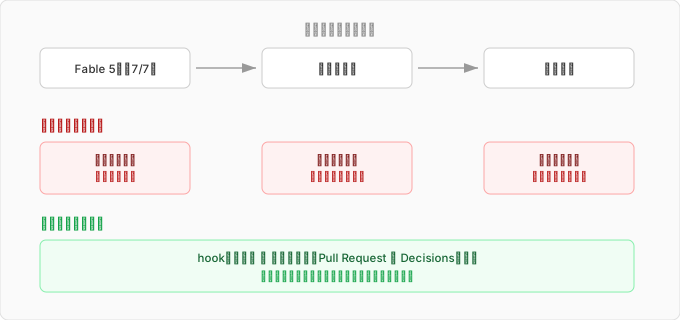
Each point on its own was minor. But every one of them, if fixed today, would still be there tomorrow no matter which AI I happened to be using. That’s when I found my answer: don’t have it produce a deliverable (a flow) — have it build an environment (a stock).
Steering the fixes toward “machinery” and “public code”
While making the fixes, I made a point of not letting anything stay scoped to just this one conversation with Fable 5.
No amount of careful prompt-wording was going to fix the freshness-check problem, since the same hole would just reopen later. So I added a small shell script that runs at session start: if a note’s timestamp is more than seven days old, it throws a warning automatically. That closes off the “written down but not actually running” failure mode, at least mechanically.
For the bloating news folder, instead of a quick manual cleanup, I implemented a proper “keep N days” setting in the collection script itself, and submitted it as a pull request to obsidian-vault-search, a repo I maintain publicly. While I was at it, I also added an “exclude this folder from search” option to the search tool. Neither of these is a private hack just for me — they’re now features that live in the repo. Once the free tier ends and Fable 5 starts costing money, whatever’s merged into main stays merged.
Recording the reasons I decided not to do something
Along the same lines, I looked into whether I could offload some lightweight tasks to a local LLM (Gemma) instead. My Mac already has a 4B-class model installed. But it only has 8GB of memory, which puts a hard ceiling on what it can realistically run.
Even accounting for that, I ended up deciding against it. Two reasons. First, the place where I’m actually spending the most (day-to-day conversation and scheduled tasks) isn’t somewhere a local model can slot into anyway. Second, output from a weaker model tends to cost more in review time than it saves — which would contradict a conclusion I’d already reached: that review time, not generation time, is the real bottleneck.
What matters here isn’t the “no” itself — it’s that I wrote down why. Next time the same idea crosses my mind (mine or another AI’s), I won’t have to redo the whole evaluation from scratch. It’s not just the features you adopt that become part of the environment — the reasons you rejected something do too.
Then I asked it to pitch me an article
Once everything was fixed, I asked, more or less as an afterthought, “Could this whole thing be a blog post?” What came back was essentially the outline of the article you’re reading right now.
Fable 5 audited the external brain. Fable 5 fixed it. Fable 5 turned the record of those fixes into a story pitch. And right now, that same Fable 5 is the one helping me write this article out of that material. It’s nested: a model that’s about to become billable in a few days made changes that will outlive that deadline, and then wrote an article using the record of those changes as its source material. Though of course, this article is itself, in the end, just another “deliverable.” What survives past the end of the free tier isn’t the article — it’s the audit and the fixes behind it.
But that doesn’t feel like much of a contradiction. Whichever model I use next, the hook still runs, the code in the public repo still works. This whole exchange is sitting in the vault too. Some time from now, when a different AI opens this vault, what it references won’t be this article — it’ll be the Decisions note behind it. Just like “why I didn’t use Gemma” got written down, this whole exercise gets recorded too, as “why I had it build an environment instead.”
Closing
When I wrote about the AI that vanished after three days, I was looking at the risk of a dependency disappearing, from the outside. This time it was the mirror image: knowing in advance that an AI was about to stop being free, what should I actually ask it to do?
The strongest models tend to get pointed at “outputs” — articles, code. But outputs can be regenerated by the next model just fine. What doesn’t get rewritten is a single hook script, a pull request merged into a repo, a Decisions note that even records why you didn’t do something. If you can see the free tier ending, spend it on things that outlast the deadline, not things you could only make within it. That way, whichever AI shows up next doesn’t have to trip over the same hole all over again.
comments powered by Disqus