What If My AI Vendor Disappeared in Three Days? Why My Second Brain Ended Up Not Locked Into One AI
Last week, a new model got cut off just three days after its public release, and the news framed it as “the blind spot of depending on foreign AI.” I won’t get into the details here, but the headline alone stopped me in my tracks. Right now, I’ve put my entire second brain and workflow on Claude Code. If Claude became unusable tomorrow, would my “brain” go down with it?
That thought sent me back to audit how my second brain is actually built. The short answer: it wouldn’t go down with it. I didn’t design it that way on purpose. Decisions I’d made for entirely different reasons turned out, later, to double as insurance.
What I’ve actually put on Claude Code
Counting it up again, it’s a fair amount. I turned an Obsidian vault into external memory, and I have it read and write there at the start of every session. I added semantic search on top. I also built a persona/MOC pair that distills who I am and maps out the terrain. Records of my mistakes, records of my judgment calls — all of it has piled up through conversations with Claude Code.
Hearing all that, it sounds like textbook lock-in. Memory I’ve spent months growing, all sealed inside one AI tool, freezing solid the instant that tool disappears. A pretty common shape of dependency.
But look inside, and it isn’t sealed at all
Except when you actually look at what’s stored, the picture changes.
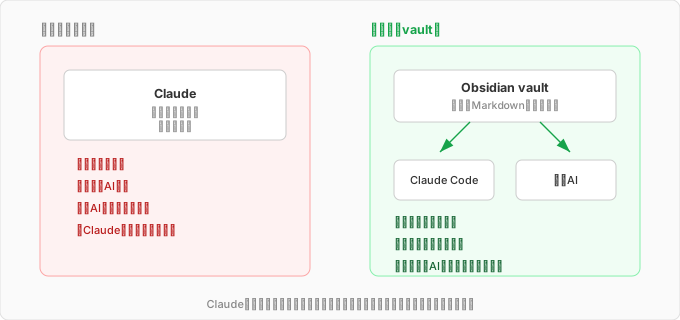
The vault itself is just Markdown files. Not on Anthropic’s servers, not in some Claude-specific format — plain text files sitting on my local disk. That was a deliberate choice from day one: when I first built the vault, I listed “opaque contents” and “can’t hand it off to another AI” as weaknesses of the official memory feature, and built the opposite on purpose. At the time I thought of it purely as a transparency choice. Looking at it now, in light of this incident, that same choice turns out to have been portability all along.
Semantic search is the same story. vault-search is a hybrid setup that blends semantic and keyword search, but neither half calls Claude’s API. Embeddings are generated locally via Ollama, and the search itself runs entirely on local Python and SQLite. If Claude Code disappeared tomorrow, vault-search "how did I handle that thing" would still work exactly as before. In fact, I built this CLI specifically so it could be invoked from any tool, not just Claude.
persona.md and MOC.md are the same. The generation step (/persona-refresh) is a Claude Code command, sure, but what it produces is just a single Markdown file. If the mechanism that built it vanished, the last-generated file would still be sitting right there on disk. Whatever AI reads it next can read it just fine.
The only Claude-specific part is “how to read it”
So what actually is Claude-specific? The rules for how to read and write all this — in other words, the contents of CLAUDE.md. At the start of a session: skim mistakes.md and persona.md to get the big picture, dig into vault details with hybrid search, never take an “unverified” label at face value — right now, these steps only exist written down in Claude Code’s config file.
But that’s still just text. If I ever needed to migrate, I could copy these read/write procedures into another AI tool’s config format and reproduce the broad strokes. I wouldn’t need to rebuild the knowledge itself from scratch. The most time-consuming part — growing the vault to a thousand-plus files — is already done. What’s left is the lightweight part: teaching a new reader how to read it.
The cost of switching AI vendors turns out to live in copying over a config, not in rebuilding knowledge. That was the single biggest thing this audit turned up.
“Don’t leave it to the AI” did double duty
Tracing back why things ended up this way, it all leads to one policy. In the first post I decided not to let the AI set the standard for what counts as memory, and in the persona/MOC post I put it into words again as not letting the AI decide what’s worth remembering. That’s the throughline.
Originally, this was purely about not letting memory become a black box. I wanted to be able to see for myself what was stored, and to set the standards myself. There was no scheme to hedge against any particular AI going away.
But push “don’t leave it to the AI” far enough, and you inevitably end up avoiding anything that exists only inside one company’s walls. Keeping the contents visible to yourself means, almost by necessity, keeping them in a form readable elsewhere too. I was chasing transparency, and portability came along for free.
There’s one more piece: the “confidence labels” I adopted while evaluating a tool called graphify take on a second meaning here too. Every claim written into the vault gets tagged verified / inferred / needs-check. Originally that was purely so my future self wouldn’t mistake an old guess for an established fact. But even if the reader changes to a different AI, the label still does its job — a new reader won’t blindly trust a guess left behind by the previous reader (Claude). It turned out to be a hedge against the writer changing too, not just the reader.
This isn’t about cutting ties
To be clear, this isn’t “I’m preparing to quit Claude.” I still use Claude Code every day, and I have no plans to switch. What I did here wasn’t an actual migration — just an audit of the existing design, to check whether I’d painted myself into a corner.
What matters, I think, isn’t cutting off dependency — it’s staying dependent while keeping the option to leave open. Rebuilding everything from scratch yourself is unrealistic, and there’s nothing wrong with using what’s convenient. But in exchange for that convenience, you should still get to choose where the things you hand over actually live. In my post about tidying up passwords, I wrote about not trusting whatever’s shown to you in the moment, and instead routing judgment through a pre-shared secret or a separate channel. This is the same idea, just aimed differently — that post was about protecting information on the human side; this one is about protecting against the AI vendor itself disappearing. Don’t bet everything on one central point — always keep a route you can move through.
The story of an AI cut off after three days was supposed to have nothing to do with me. But once I asked “what if it were my AI that disappeared” and actually went digging, I found that old design decisions had quietly been insurance all along. Since I never set out to build that defense, finding it there felt like a small, unearned win.
comments powered by Disqus